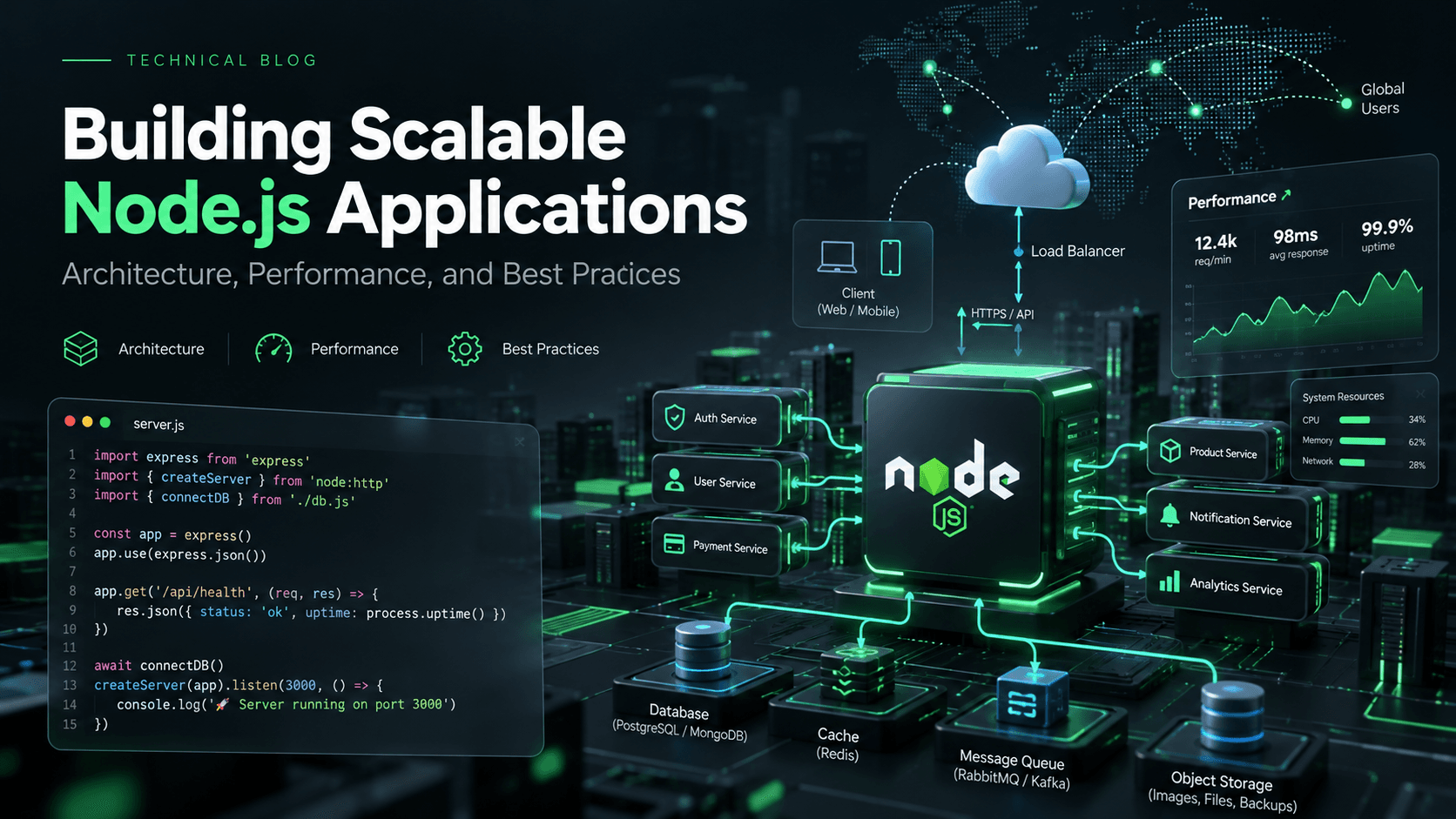
Introduction
Node.js has become a powerful choice for developing modern backend services, particularly applications that require high concurrency, real-time communication, and efficient I/O operations.
However, choosing Node.js alone does not guarantee scalability. The architecture of an application, the way it handles asynchronous operations, and its approach to error handling and resource management all play critical roles.
In this article, I'll explore several principles that help make Node.js applications reliable, maintainable, and ready for production.
1. Understanding the Event Loop
One of Node.js's defining characteristics is its event-driven, non-blocking I/O model.
Rather than creating a separate JavaScript thread for every request, Node.js uses an event loop to coordinate asynchronous operations.
For example:
import { readFile } from "node:fs/promises";

async function loadConfiguration() {
  const content = await readFile(
    "./config.json",
    "utf8"
  );

  return JSON.parse(content);
}
While the application waits for the file operation, the event loop can continue processing other work.
This architecture is particularly effective for I/O-intensive applications, including API gateways, data aggregation services, and real-time applications.
An important distinction: asynchronous programming does not automatically make CPU-intensive work non-blocking. Heavy computation can still block the event loop and reduce responsiveness.
2. Organizing Applications into Layers
As applications grow, maintaining clear separation of responsibilities becomes increasingly important.
A common Node.js backend structure might look like this:
src/
  routes/
  controllers/
  services/
  repositories/
  middleware/
  config/
  utils/
Each layer serves a specific purpose.
- Routes define API endpoints.
- Controllers handle HTTP request and response concerns.
- Services implement business logic.
- Repositories abstract database access.
- Middleware handles cross-cutting concerns such as authentication and logging.
This separation improves testability and reduces coupling between business logic and infrastructure.
For larger systems, organizing code around business features can be even more effective than organizing entirely around technical layers.
3. Handling Asynchronous Operations Efficiently
Consider an endpoint that needs customer details and order history from two independent services.
Executing these requests sequentially introduces unnecessary latency.
const customer = await getCustomer(customerId);
const orders = await getOrders(customerId);
When the operations are independent, they can be executed concurrently:
const [customer, orders] = await Promise.all([
  getCustomer(customerId),
  getOrders(customerId)
]);
This can reduce the total response time significantly.
However, concurrency must be controlled. Launching thousands of simultaneous database queries can overload downstream systems.
Production applications should use appropriate concurrency limits, timeouts, and backpressure strategies.
4. Designing for Reliability
A scalable application must also handle failures predictably.
Several practices are particularly important:
- Validate incoming requests at system boundaries.
- Use centralized error handling.
- Implement timeouts for downstream services.
- Introduce retries only where operations are safe to repeat.
- Use structured logging and distributed tracing.
- Keep secrets and configuration outside source code.
- Monitor event-loop delay, memory usage, and request latency.
Graceful shutdown is another frequently overlooked requirement. When a service receives a termination signal, it should stop accepting new work, finish or cancel ongoing operations appropriately, and release resources.
5. Choosing the Right Scaling Strategy
Node.js works extremely well for many network-intensive services, but different workloads need different scaling approaches.
For CPU-intensive processing, Worker Threads or separate worker services can prevent heavy computations from blocking request handling.
For background tasks, a queue-based architecture can isolate workload processing from the request-response lifecycle.
Horizontal scaling across multiple application instances can improve capacity and availability, provided the application handles shared state and dependencies correctly.
Conclusion
Building scalable Node.js applications requires more than writing asynchronous JavaScript.
The strongest solutions combine clear architecture, appropriate concurrency, resilient integration patterns, observability, and thoughtful infrastructure decisions.
My key takeaway: Scalability should be an architectural consideration from the beginning, but complexity should be introduced only when real requirements justify it.
A well-structured, observable application is often more valuable than an unnecessarily complicated distributed system.