Introduction
Large Language Models have transformed how we interact with software. However, a language model operating without access to external systems is limited in what it can accomplish.
Real-world AI applications often need to retrieve information, interact with databases, inspect files, or perform actions through business APIs.
Historically, these integrations required custom implementations for different models, applications, and services.
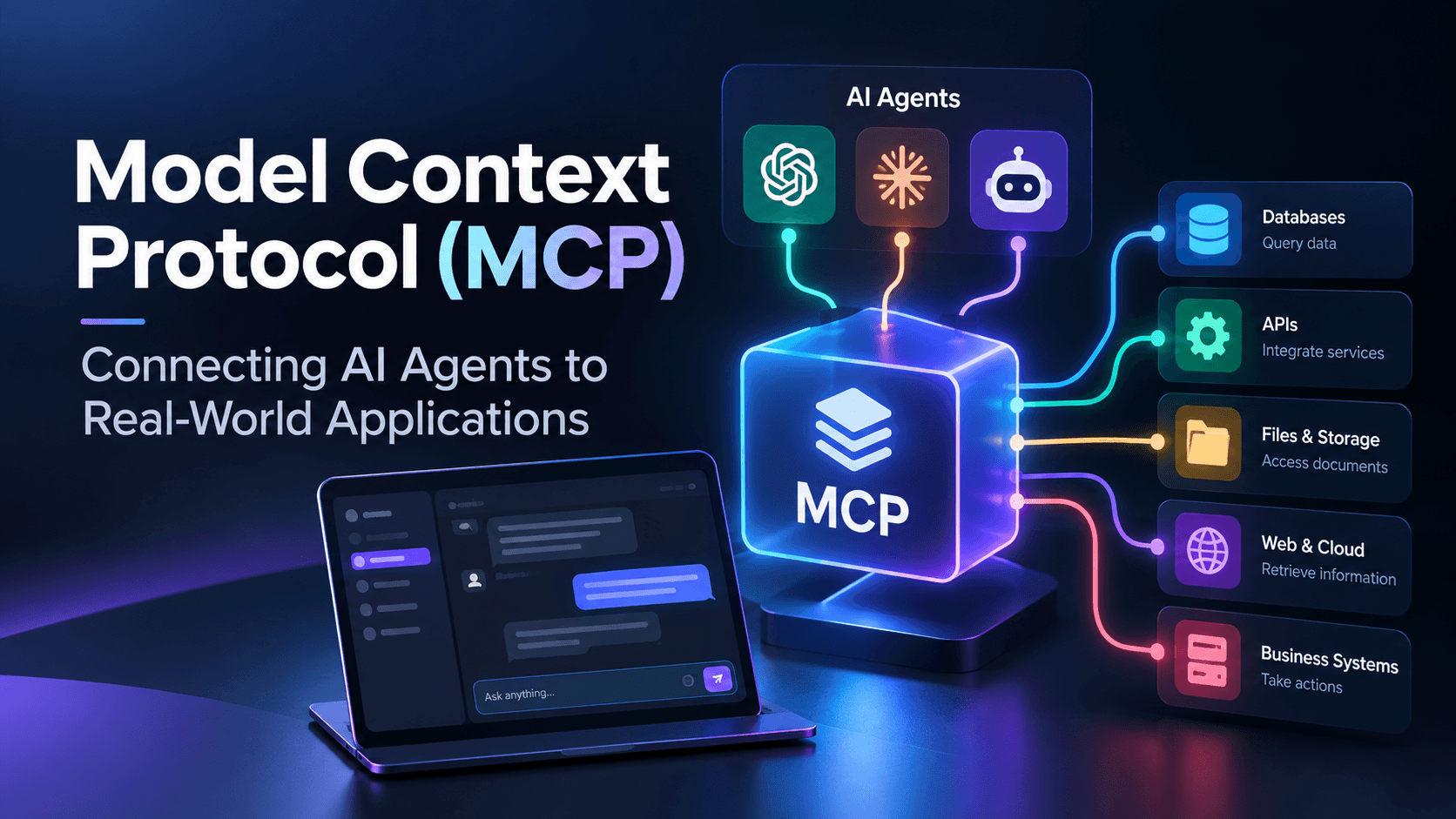
Model Context Protocol (MCP) introduces a standardized approach to connecting AI applications with external capabilities.
For software engineers and architects, MCP represents an important building block in the evolution of AI-enabled applications.
1. What Is MCP?
Model Context Protocol is an open protocol that allows AI applications to discover and interact with capabilities exposed by external servers.
Instead of creating a completely custom integration for every AI application, developers can expose functionality through a consistent protocol.
Consider an AI assistant that needs to retrieve a customer's order status.
Without a standardized integration, developers may need to build custom connectors and tool definitions for each AI platform.
With MCP, an application can expose a tool such as:
get_order_status(order_id)
A compatible AI host can discover that tool, provide the required arguments, and receive structured results.
MCP standardizes the integration mechanism; it does not eliminate the need for authentication, authorization, or appropriate application logic.
2. Understanding MCP Architecture
The architecture consists of three central concepts.
MCP Host: The AI application that coordinates user interaction and model behavior.
MCP Client: The protocol component within the host that communicates with an MCP server.
MCP Server: The service that exposes tools, resources, and prompts to connected clients.
A simplified interaction looks like this:
User
 |
 v
AI Application (Host)
 |
 v
MCP Client
 |
 v
MCP Server
 |
 +-- Tools
 |
 +-- Resources
 |
 +-- Prompts
 |
 v
Business APIs / Databases / Services
An AI application can connect to multiple MCP servers, each providing a different set of capabilities.
This separation makes it possible to introduce new integrations without tightly coupling every AI application to every business system.
3. Tools, Resources, and Prompts
MCP defines three important server-side primitives.
Tools
Tools expose functions that an AI application can invoke.
Examples include:
- Retrieving an order status.
- Querying an inventory service.
- Creating a support ticket.
- Searching an internal knowledge base.
Tools may produce side effects, so authorization and validation are essential.
Resources
Resources expose data that an application can retrieve and provide as context.
Examples include configuration information, documentation, or reference material.
Prompts
Prompts provide reusable interaction templates that help users initiate consistent workflows.
For example, a support application might expose a prompt template for summarizing a customer incident.
Together, these primitives create a flexible integration model for AI applications.
4. MCP in Enterprise Architecture
Consider an organization operating several backend services:
AI Assistant
     |
     v
MCP Integration Layer
     |
     +-- Customer Service
     |
     +-- Order Management
     |
     +-- Inventory Service
     |
     +-- Knowledge Base
The MCP layer can expose selected business capabilities to an AI application.
For example, a customer-support assistant might retrieve customer information, check shipment status, and prepare a response using information returned from authorized services.
The underlying business systems can continue using established technologies such as .NET, Node.js, SQL Server, or cloud-native APIs.
MCP does not require replacing existing infrastructure. It can provide a standardized interface above carefully selected functionality.
5. Security Considerations
Providing AI systems with access to external tools introduces significant security responsibilities.
Several principles are particularly important.
Least-privilege access: Expose only the operations an application genuinely requires.
Authentication and authorization: Validate the identity and permissions of callers, especially for remote services.
Input validation: Treat model-generated tool arguments as untrusted inputs.
Human approval: Require explicit user confirmation for sensitive or destructive operations where appropriate.
Auditability: Record tool invocations and important business actions for operational review.
Data protection: Avoid exposing unnecessary personal information, credentials, or confidential records.
An AI assistant should never be treated as an inherently trusted actor merely because it is operating within an organization's infrastructure.
6. Where MCP Fits in the Future of Software Development
As AI applications become more capable, their value will increasingly depend on how safely and reliably they interact with existing business systems.
MCP can help teams standardize these interactions.
However, the protocol itself is only one part of the architecture.
Production AI systems still require observability, permission management, tool-result validation, error handling, and careful evaluation of model behavior.
For engineering teams, understanding these integration boundaries will be just as important as learning how to build the AI-facing interfaces.
Conclusion
Model Context Protocol offers an important architectural approach to building interoperable AI integrations.
Its greatest value is not simply allowing language models to call APIs. It is providing a shared interface for connecting AI applications with external capabilities.
My key takeaway: The future of enterprise AI will depend not only on model intelligence but also on the reliability, security, and architectural quality of the systems those models interact with.
MCP provides a useful foundation for that integration layer.